Why Gym Machines Feel Wrong at First - and the Adjustments Nobody Shows You
Quick Answer: Most gym machines have three to five adjustment points, and the single most important rule is that the machine’s pivot must line up with your joint. If the seat is too low on a chest press, the movement path is wrong for your shoulder no matter how good your form is. Spend the first thirty seconds of every machine adjusting it, write down the numbers, and never assume the previous user’s setting is close to yours.
You sit down, the movement feels awkward, and you conclude that machines are not built for your body.
Half true. They are built for an average - and they were also built with adjustment knobs specifically so that nobody has to be that average.

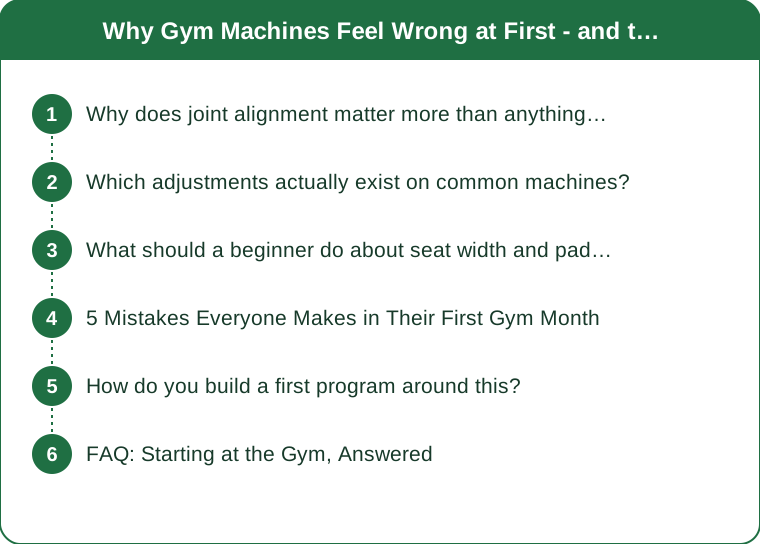
Why does joint alignment matter more than anything else?
Every rotary machine has a pivot point, and the whole design assumes your joint sits at that pivot. Leg extension aligns with the knee, arm curl with the elbow, lateral raise with the shoulder.
Misalignment changes the resistance curve of the exercise, so the hardest point of the movement lands somewhere other than where the machine intended - usually at a joint angle where you are weakest.
It also creates shear rather than clean loading, which is where discomfort and irritation come from on machines that are supposedly the safe option.
Look for the pivot marker. Most machines have a visible bolt, sticker or coloured cap at the axis. Adjust the seat until your joint centre is level with it.
For a leg extension, this is the seat back position, not the seat height - sliding the back pad forward or back is what moves your knee relative to the pivot. Almost everyone adjusts the wrong thing here.
And if a machine cannot align to you at any setting, use a different machine. That is not failure; it is the machine being outside its design range, which happens at both ends of the size distribution.
Which adjustments actually exist on common machines?
Chest press: seat height and sometimes handle depth. Set the seat so the handles are level with mid-chest, roughly nipple height, not with your shoulders or your chin. Handle depth controls the starting stretch and should not put your elbows far behind your torso.
Lat pulldown: thigh pad height. Set it so your thighs are snug and you cannot lift off the seat. Loose thigh pads are the reason people cannot pull heavy without rising out of the seat.
Leg press: back pad angle and foot plate position. Set the back angle so your lower back stays in contact through the whole range, and stop the descent before the pelvis tucks under.
Seated row: chest pad depth and seat height. The pad should support the chest without preventing the shoulder blades from moving. Too tight is as bad as absent.
Leg curl and extension: back pad and range limiter. The range limiter is the most-ignored control in any gym and the most useful for anyone whose comfortable range differs from default.
Shoulder press: seat height, set so the handles start at roughly ear or shoulder height rather than above the head.
And most machines list a range-of-motion setting that determines how far the weight travels before you start. Shortening it to a range you control well is a legitimate and underused choice.
What should a beginner do about seat width and pad size?
Machines with narrow seats or fixed side rails are a fit problem, not a you problem. Skip them and use an alternative that trains the same pattern.
Almost every machine exercise has a free-weight or cable equivalent, and cables in particular accommodate every body dimension because there is no seat imposing a geometry.
Cable chest press, cable row, cable pulldown and dumbbell versions of everything cover the entire machine circuit between them.
A bench with an adjustable back replaces most seated machines and lets you set your own angle.
Machines with pads that dig rather than support are usually adjustable, and where they are not, a folded towel between you and the pad is a completely reasonable fix that trainers use routinely.
And plate-loaded machines often have more clearance than selectorised ones, so if the pin-loaded chest press feels cramped, the plate-loaded one across the floor may be fine.

5 Mistakes Everyone Makes in Their First Gym Month
Leaving the machine on the previous person’s settings. They were a different height with different limb proportions. Their setting is not a starting point; it is noise.
Not writing the numbers down. Every machine has numbered settings, and recording them means never re-solving the problem. Two lines in your phone per machine covers your entire program.
Chasing full range of motion regardless of comfort. Full range on a machine is defined by the machine’s geometry, not by your joint. Use the range you control without discomfort and expand it as you adapt.
Going too heavy to test the limit. The first month is about establishing the movement pattern, and the load that teaches it is well below the load that challenges you. Two clean exercises done well beat a full program done approximately.
Being embarrassed to adjust things. The knobs exist because bodies differ. Adjusting a machine for thirty seconds is what the equipment expects, and every experienced lifter in the room does it. Nobody is watching, and the ones who would notice are the ones who most approve.
How do you build a first program around this?
Pick one push, one pull, one leg movement and one core movement. That is a complete program for the first month and it will produce real progress.
Chest press, seated row, leg press and a plank variation is a defensible starting four, all machine-based and all adjustable.
Two sets of 10 to 12 with two minutes rest, twice a week, is enough stimulus to adapt without producing the soreness that ends most beginner programs in week two.
Warm-up sets matter more than working sets in month one, because they are where you rehearse the pattern with no fatigue interfering.
Add weight when the last rep of the second set still feels controlled, typically the smallest increment available.
Log everything - machine, setting numbers, weight, reps. This log is the single most valuable object you will produce in your first month.
And expect stamina to improve before anything else. The first visible change is usually that the same session stops feeling hard, which happens weeks before strength numbers move much. That is progress, and it is the part most people fail to count.
FAQ: Starting at the Gym, Answered
How do I know if a machine is set up right for me?
Your joint should line up with the machine’s pivot, the movement should feel smooth with no pinching, and you should be able to complete the range without shifting position or lifting off the seat.
Is it rude to adjust a machine someone else set up?
No. Adjusting between users is the expected behaviour and the reason the adjustments exist. Reset it afterwards if you want to be courteous, though nobody requires it.
What if no setting fits me?
Use a cable or free-weight alternative that trains the same pattern. Cables have no fixed geometry and accommodate essentially any body dimension.
Should I start with machines or free weights?
Machines are a reasonable start because they constrain the movement path while you build confidence, and they are easy to load safely alone. Adding free weights and cables after a few weeks is a good progression.
How long before I see progress?
Strength gains often show within two to four weeks, largely from neural adaptation. Stamina improves first, visible changes take longer, and the log is what makes early progress obvious when the mirror does not.
Do I need a trainer?
Not necessarily, but one or two sessions purely to set up machine positions and record the numbers is excellent value even if you train alone afterwards. This is general information, not medical advice.
TL;DR:
- Line your joint up with the machine’s pivot - it matters more than any other cue on any machine.
- Every machine has three to five adjustments, and the previous user’s setting tells you nothing.
- Write your setting numbers down once and never solve the problem again.
- If no setting fits, use a cable or free-weight equivalent; cables have no imposed geometry.
- Two exercises done well beat a full program done approximately in month one.
- Stamina improves before strength numbers do - count it, because it is real progress.
Adjusting equipment for thirty seconds is what the knobs are for. This is general information, not medical advice.
Keep Reading
This article is for general informational and styling purposes only. Fit, sizing, and product availability may vary.
