Why Resting Longer Between Sets Speeds Up Beginner Progress
Quick Answer: Strength work runs on a fuel system that takes about two to three minutes to recharge after a hard set — rest less, and your next set starts on a half-charged battery: fewer good reps, earlier form breakdown, and a smaller training signal from the same effort. Beginners who rest 30 to 45 seconds are not being efficient; they are converting a strength workout into a sloppy cardio session and then blaming their progress. The prescription is simple: two to three minutes after compound lifts, 60 to 90 seconds after smaller movements — and permission to sit down while you do it.
Rest is not the pause between the workout. For strength, rest is half the workout. Here is the case, and what to do with the minutes.

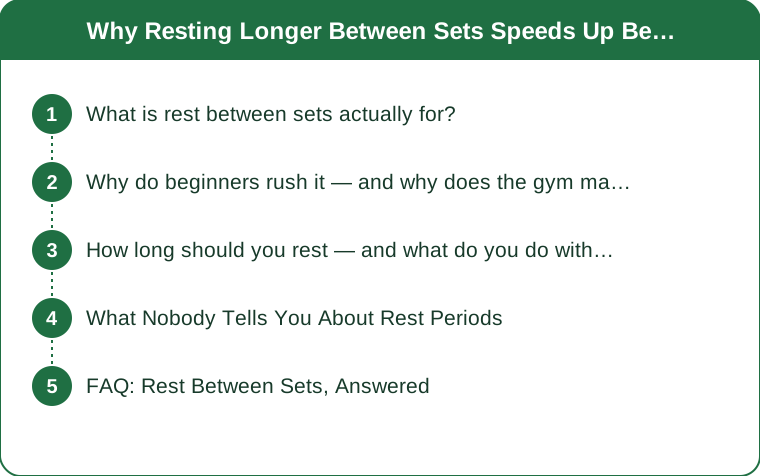
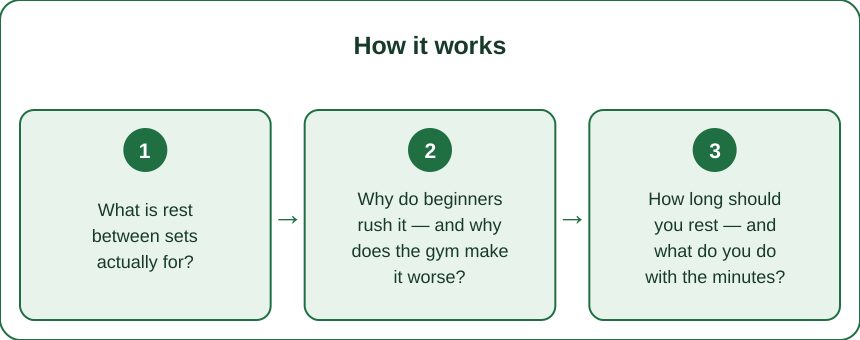
What is rest between sets actually for?
Recharging the specific fuel that hard sets run on.
The first seconds of any heavy effort draw on a fast, local energy system — phosphocreatine — that pours out power instantly and empties within about ten to fifteen seconds of real work. Refilling it is time-dependent: roughly half comes back in 30 seconds, most in two minutes, nearly all in three. No breathing technique or willpower accelerates it meaningfully. It is a countdown, and it runs the same for everyone from beginner to record-holder.
Start a set at half-charge and the set is different in kind, not just harder: the bar moves slower from rep one, the target muscles fail early, and — this is the part that matters for beginners — helper muscles and momentum take over to finish reps the fresh system would have owned. Your squat quietly becomes a back exercise. Your row becomes a shrug with a swing. The logbook says the set happened; the muscles you meant to train received a fraction of the message.
Muscle grows in response to tension delivered through good positions with progressive load. Every one of those levers depends on the set being performed well, and performing well depends on arriving recharged.
The reframe that unlocks it: the rest is not you failing to work. The rest is the machine reloading — and letting it finish is the difference between five productive sets and five rehearsals of fatigue.
Why do beginners rush it — and why does the gym make it worse?
Three honest reasons, all fixable once named.
Reason one: standing still feels observed. Working looks like belonging; resting feels like being conspicuous — and for anyone already managing gym self-consciousness, especially in a bigger body braced for imagined judgment, the urge to look perpetually busy is powerful. So the rest gets cut short, not for training reasons, but to escape a feeling. It deserves saying plainly: the strongest people in any gym rest the longest, openly, sitting down, staring at nothing. Long rest is not what beginners do wrong; it is what serious lifters visibly do right. Resting like you belong there is accurate — you do.
Reason two: the cardio-class instinct. Most people arrive at lifting from a world where harder always means less rest — spin, HIIT, bootcamps. Strength runs the opposite economy: the effort is the set, and the rest purchases the next one. More rest is not softer training. It is the correct currency for this purchase.
Reason three: sweat accounting. A rushed workout leaves you more breathless and drenched, which feels like more results. But the breathlessness came from incomplete recovery, not extra stimulus — you paid more discomfort for less adaptation. Strength progress is measured in the logbook, not the puddle.
And underneath all three: nobody told them the number. Rest prescriptions rarely make it onto beginner programs, so people default to the length of a fidget — and the length of a fidget is 40 seconds.

How long should you rest — and what do you do with the minutes?
The working numbers, then the toolkit for occupying them.
After compound lifts — squats, deadlifts, presses, rows: two to three minutes. These movements drain the most and reward full recharge the most. When a set felt heavy or you are pushing weight up this week, take the full three without apology.
After smaller single-muscle movements — curls, raises, machine isolation: 60 to 90 seconds. Less total system drain, faster turnaround.
The self-check that beats every timer: you should start the next set able to speak a full sentence without gasping, with the last set’s burn fully faded. Still panting? The countdown is not done, whatever the clock says.
Use a timer anyway — phone or watch, started at the end of each set. Untimed rest drifts short under self-consciousness and drifts long under Instagram. The timer removes both failure modes and, usefully, gives the resting minutes a visible legitimacy: you are not loitering, you are mid-interval.
Fill the minutes with jobs: log the set you just did (weight, reps, how it felt), sip water, set up the next station, run a breathing reset — in through the nose, long exhale, shoulders down from your ears. On lower-body days, 90 seconds of the rest can be gentle walking; it aids recovery and satisfies the urge to move.
Dress so the rest is actually restful: clothes you are comfortable sitting, bending, and being stationary in — squat-proof leggings that stay put without tugging, a top long enough to sit down in without adjustment. Fidgeting with clothing is where rushed rest goes to hide.
Same five sets, fully recharged, logged and unhurried: that is the entire upgrade.
What Nobody Tells You About Rest Periods
Sitting down is allowed. The bench you just pressed on, the box by the rack, the seat of the machine you are using — sitting between sets is universal serious-lifter behavior, not weakness. Claiming the seat also politely signals the station is occupied, which solves a beginner anxiety of its own.
Longer rest makes the workout barely longer. The arithmetic surprises everyone: adding a minute to fifteen rests is fifteen minutes — usually recovered by wandering less, deciding faster, and redoing zero garbage sets. Most people finish in the same hour, having trained better.
Supersets are the honest shortcut. Pressed for time? Pair non-competing exercises — a press with a row, a leg movement with a curl — resting 60 to 90 seconds between them. Each muscle still gets its full recharge while the clock stays busy. That is the legitimate version of what rushed rest pretends to be.
Rest needs grow as you get stronger. The set that needed 90 seconds in month one needs three minutes in month eight, because you can now generate enough effort to actually drain the system. Needing more rest over time is a progress marker, not a fitness failure.
The phone is the real risk of long rest. Two minutes becomes seven inside one scroll. Use the timer, log the set, and keep the phone in workout mode — the rest should recharge the muscle, not restart the feed.
FAQ: Rest Between Sets, Answered
Does resting longer burn fewer calories?
Slightly, within the session — and it builds more muscle across months, which raises what you burn all day, every day. Optimizing a strength session for in-session calorie burn is trading the asset for the receipt. If burn matters to you, add a ten-minute walk after lifting and keep the rests honest.
My gym gets crowded and I feel guilty holding equipment for three minutes.
Normal etiquette covers you: working through your sets with normal rest is standard use, not hogging. In a genuine crunch, offer to let someone work in on alternating sets, or run supersets across two quieter stations. What you owe the room is efficiency between exercises — not sprinting between sets.
Should I rest longer when the weight goes up?
Yes — heavier relative loads drain more and deserve the full three minutes, sometimes a bit more on a top set. The week you add weight is exactly the week to be most generous with the countdown.
Is there any strength benefit to short rests at all?
Short rests train endurance qualities and have a place in conditioning circuits — a legitimate goal, just a different one. For the beginner goal of getting stronger and building muscle with good form, full recharge wins, and it is not close. Pick the goal, then pick the rest.
TL;DR:
- Hard sets run on a fuel system that needs two to three minutes to recharge; rushed rest means weaker, sloppier sets and a smaller growth signal from the same effort.
- Beginners rush rest to avoid feeling watched — but visible, seated, unhurried rest is what the strongest people in the room are already doing.
- Numbers: two to three minutes after compounds, 60 to 90 seconds after isolation, full-sentence breathing before the next set, timer running.
- Fill the minutes with logging, water, setup, and breathing; supersets are the honest time-saver, and rest needs growing over time is a progress sign.
Next session, run your usual workout with only one change: full timed rests, seated, set logged each time. Compare the last set of each exercise to last week’s — that one comparison is usually the whole argument, settled.
See It in Motion
Seen here: High Waist Embossed Yoga Leggings with Side Pockets — shop it on bubblelime.com
Keep Reading
This article is for general informational and styling purposes only. Fit, sizing, and product availability may vary.
