Why the First Ten Minutes at the Gym Are the Hardest - and How to Build an Arrival Routine
Quick Answer: The first ten minutes are hardest because you are making a dozen unscripted decisions in an unfamiliar place while feeling watched. Decision load plus self-consciousness is a much bigger barrier than the exercise itself. The fix is a fixed arrival routine: the same locker area, the same first machine, the same five minutes of warm-up, every single time. A scripted opening removes the decisions and the anxiety fades with them - usually within three or four visits.
Once the opening is automatic, the rest of the session follows.
Here is how to build one that works.

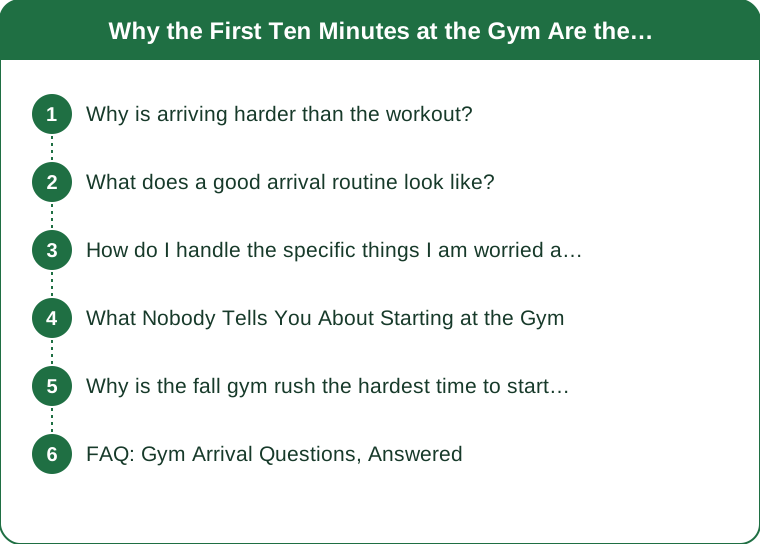
Why is arriving harder than the workout?
Because arriving is where all the unscripted decisions live.
Where do I put my bag? Which machine is free? Is that person using this? How do I adjust this seat? Am I in someone’s way? Every one of these is a small decision, and they arrive in a burst, in public, before you have settled.
Decision load is genuinely fatiguing, and it is highest in an unfamiliar environment where nothing is automatic yet.
Add self-consciousness on top. People consistently overestimate how much others notice them - a well-documented tendency often called the spotlight effect. In a gym, where mirrors and strangers are unavoidable, it is amplified.
The reality is more mundane. Most people in a gym are focused on their own session, their own count, or their phone. Attention in a gym is overwhelmingly self-directed.
But knowing that does not dissolve the feeling, which is why the practical answer is not to reason your way out of it. It is to remove the decisions, so there is less to feel exposed while doing.
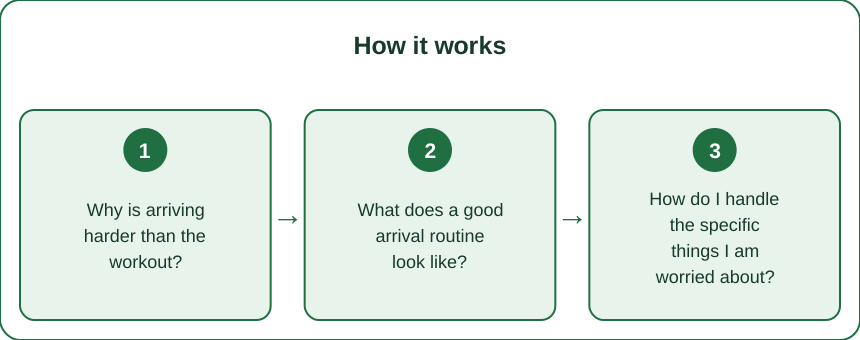
What does a good arrival routine look like?
Same sequence, same order, every visit. The specifics matter less than the sameness.
1. Same entry path. Same door, same locker area, same corner. Familiar space stops being scanned as new, which frees up a surprising amount of attention.
2. Bag stowed the same way. Decide once what comes with you - water, towel, phone - and never re-decide.
3. Five minutes on the same cardio machine. This is the anchor. It is unambiguous, nobody watches, and it gives you five minutes to look around and see what is free while doing something legitimate. Pick a machine you can always get - if the treadmills are busy at your usual time, choose the bike.
4. Same first exercise. Written down before you arrive. The first exercise should be one you know exactly how to set up - not the day’s hardest or newest movement.
5. Then follow the written plan.
Write the whole session out beforehand. A plan in your phone or on paper eliminates the largest source of mid-session anxiety, which is standing in the middle of the floor deciding what to do next. Standing still and deciding is the most exposed you will ever feel in a gym.
How do I handle the specific things I am worried about?
The common ones have straightforward answers.
How do I know if a machine is free? If nobody is on it and there is no towel or water bottle on it, it is free. If you are unsure, ask - “are you using this?” is completely normal and gets a one-word answer.
How do I adjust the seat? Most machines have a diagram on them showing the adjustment. Take the thirty seconds to read it - and if you cannot work it out, staff are there for that. Asking staff how to use a machine is the single most normalized interaction in a gym.
What if I use the wrong weight? Start lighter than you think. The first session is for learning the movement, and everyone increases from there. Nobody is tracking your stack.
What if I need to rest longer between sets? Rest as long as you need. Rest periods vary widely and nobody is timing you.
What if the free weight area is intimidating? Go at a quieter hour first, or start with machines and dumbbells near the edge of the area. Build familiarity in stages rather than requiring yourself to be comfortable everywhere on day one.
And go at the same time. The same time of day means roughly the same crowd, the same machines free, the same rhythm - and familiarity is the whole mechanism here.

What Nobody Tells You About Starting at the Gym
Five things that make the first month easier.
Everyone was new, and most people remember it clearly. The experienced-looking person on the next machine has their own memory of standing in the doorway. Sympathy is far more common than judgment.
The staff genuinely want to help. Showing someone how a machine works is a normal part of their job, and a single fifteen-minute walkthrough removes most of the environmental unknowns at once. Ask on a quiet weekday.
You will feel less watched by visit four. The anxiety decreases mostly through repetition, not through insight. The environment stops being novel and the brain stops flagging it - which means the fastest route through it is going back sooner, even briefly.
A short session counts. Twenty minutes that happened beats sixty that did not. In the first month, frequency matters more than session quality, because you are building a habit and a familiar environment, not fitness adaptations.
And a bad first session predicts nothing. Almost everyone has one - wrong weight, confusing machine, awkward moment. The people who continue are not the ones who avoided that session; they are the ones who came back after it.
Why is the fall gym rush the hardest time to start - and how do you handle it?
September is the busiest new-member season of the year, and it works against a beginner in specific ways.
Crowds peak. More people means more waiting for machines, more decisions about what to do instead, and more perceived observation. Every mechanism in this article gets worse in a crowded gym.
Which makes a plan more valuable, not less. A written session with a backup for each exercise - if the leg press is busy, do this instead - removes the exact decision that crowding creates.
Go at off-peak times if you possibly can. Mid-morning, early afternoon, and later evening are typically far quieter than 6 p.m. The difference in how a gym feels between peak and off-peak is enormous, and for a first month it is worth arranging around.
The rush also ends. Attendance typically thins substantially within a couple of months, which means the crowded version you are experiencing is temporary. Outlasting it is genuinely the whole strategy.
And the seasonal timing works in your favor otherwise. Fall brings fixed schedules after the summer, cooler weather that makes indoor training appealing, and a long stretch of routine ahead - which is exactly the environment a new habit needs.
FAQ: Gym Arrival Questions, Answered
Should I book an induction or trainer session?
If it is offered, yes - a single session removes most of the environmental unknowns, which is the real barrier. It is not about needing a program.
What if I have to walk past the free weights to get where I am going?
Then you walk past them. Nobody in that area is evaluating people walking through, and after four or five visits the route stops registering as a thing you are doing.
Is it okay to just do cardio for the first few weeks?
Completely. Building the habit of arriving is the first job, and it is a real one. Strength work is worth adding when the arriving part is automatic - which is easier to judge than it sounds.
TL;DR:
- The first ten minutes are hard because of decision load plus self-consciousness, not because of the exercise.
- Build a fixed arrival routine: same path, same locker, same five-minute warm-up machine, same first exercise.
- Write the session down beforehand. Standing in the middle deciding what to do next is the most exposed moment.
- Ask staff how machines work - it is the most normal interaction in the building.
- It fades by around visit four, through repetition rather than insight.
- In the September rush, go off-peak and have a backup for each exercise.
Write tomorrow’s opening five minutes down tonight. That is the part that gets people through the door, and it is the part almost nobody plans.
Keep Reading
This article is for general informational and styling purposes only. Fit, sizing, and product availability may vary.
