Why Two Exercises Done Well Beat a Full Program in Month One
Quick Answer: In the first month, adherence and technique are the limiting factors, not training volume. A two-exercise session done twice a week produces most of the available early adaptation, takes 20 minutes, and is short enough that missing it requires a real obstacle rather than a mild one. Complexity in month one costs you the thing that matters most — the habit — in exchange for a training stimulus you are not yet able to recover from anyway.
Add exercises when the two are automatic. That point usually arrives in four to six weeks, and everything added after it sticks.

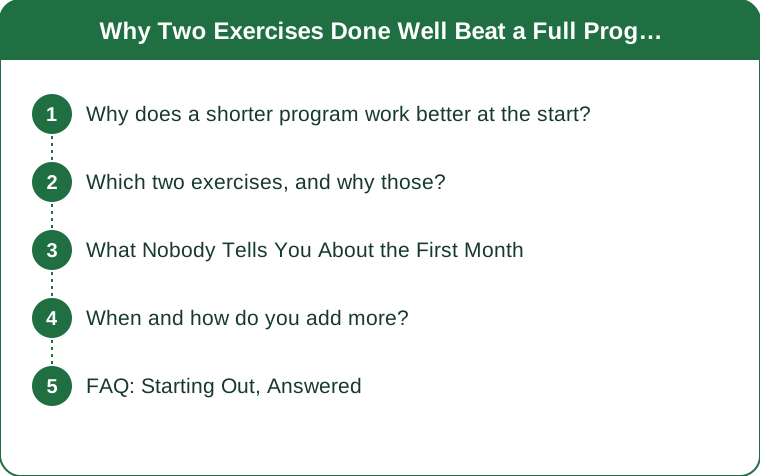
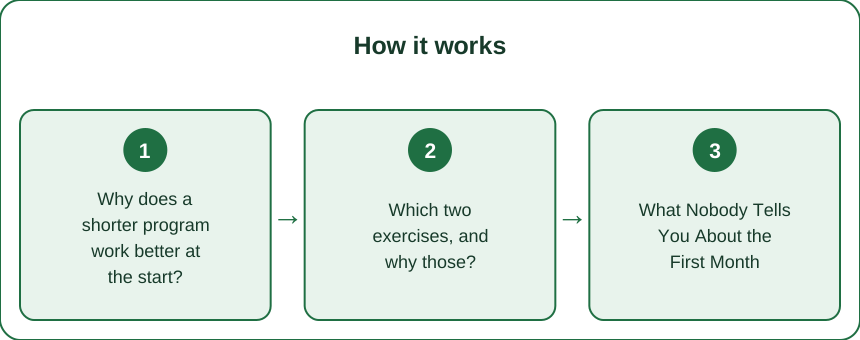
Why does a shorter program work better at the start?
Because the failure mode of month one is stopping, not under-training.
A beginner gains strength primarily through neural adaptation — the nervous system learning to recruit muscle more effectively. This happens with remarkably little volume. Two to three sets of a movement, twice a week, produces most of the available early gain. Adding a fourth and fifth exercise adds fatigue and time cost without adding much stimulus.
Meanwhile the actual risk is attrition. The most common pattern is an ambitious program, two strong weeks, a missed session, a sense of having fallen behind, and then nothing.
A 20-minute session is robust against the things that end programs. A late meeting, a bad night’s sleep, a busy weekend — none of these are enough to derail a session that short. A 75-minute session is derailed by all of them.
There is a second effect that matters more than it sounds. Doing something short and finishing it builds a different self-image than doing something long and abandoning it. Six weeks of completed short sessions produces a person who trains. Six weeks of half-finished long sessions produces a person who used to try.
The volume can come later, and it will come easily, because by then it will be added to something that exists.
Which two exercises, and why those?
One push or squat pattern, and one pull. That covers the most muscle mass for the least complexity.
A supported squat pattern — a goblet squat to a box, or a leg press. The box removes the depth judgment, provides a consistent target, and makes the movement far less intimidating. Leg press is an excellent alternative if balance or knee comfort is a concern, because it removes the stabilization demand entirely.
A supported row — chest-supported dumbbell row, seated cable row, or machine row. Pulling is where most beginners are weakest, it improves posture noticeably within weeks, and supported versions remove the lower back from the equation.
These two together cover legs, glutes, back, and arms. Between them you are training the large majority of your muscle mass, which is the whole point of picking only two.
Start with three sets of 8 to 12 repetitions, with a weight where the last two reps are challenging but your form does not change. Rest 90 seconds to two minutes between sets — genuinely, by a clock. Short rests make the sets harder without making them more productive at this stage.
Add a small amount of weight when you complete all sets at the top of the rep range with clean form. That progression rule alone will drive months of improvement without any change to the program.

What Nobody Tells You About the First Month
The soreness peaks after session two or three, not session one. Delayed onset muscle soreness ramps up as you start doing more unfamiliar movement. It is not a sign of doing it wrong, and it diminishes substantially by week three.
Machines are not the beginner version of free weights. They are a legitimate tool with a real advantage — they fix the movement path, which lets you load a muscle without also managing balance. Building strength on machines for two months and moving to free weights later is a perfectly sound path.
Nobody is watching. This is said often and rarely believed. The practical version: everyone in the gym is managing their own set count, their own rest timer, and their own discomfort. Attention in a gym is overwhelmingly self-directed.
Bring the session written down. Two exercises, sets, reps, and last week’s weights on a phone note. It removes every in-gym decision, which removes most of the friction, and it means you never stand around wondering what to do next.
The gym at its quietest is a different place. Mid-morning and early afternoon on weekdays are dramatically less busy than 6pm. If crowding is a barrier, changing the time removes it more effectively than any amount of resolve.
When and how do you add more?
When the two exercises require no thought, which is usually four to six weeks.
The signal is not a date. It is that you arrive, set up, and execute without deliberating — you know the weight, you know the setup, and the movement itself no longer takes concentration. That is the point where you have spare capacity for something new.
Add one exercise, not three. A hip hinge pattern is the usual next choice — a hip thrust or a supported deadlift variation — because it covers the posterior chain that the first two only partly reach.
Then wait another three to four weeks before adding again. A reasonable end state after three months is four to five exercises, twice a week, at about 40 minutes. That is a genuinely productive program, and it was built by addition rather than by starting there and subtracting through attrition.
Add a third day only after the two days have been consistent for two full months. Frequency is harder to sustain than duration, and the third day is where most people’s schedules break.
And expect the first plateau around month three. That is normal and it is where a slightly more structured progression becomes useful — but that is a good problem, and it belongs to a person who has already been training for three months.
This is general information, not medical advice. Check with a clinician before starting a new exercise program if you have any relevant health conditions.
FAQ: Starting Out, Answered
Is twice a week really enough?
For a beginner, yes. Twice weekly resistance training produces the large majority of the strength gain that three times weekly does in the first few months. The third session becomes more valuable later.
Should I do cardio too?
If you want to and it does not compete with the two sessions. Walking is the easiest addition because it requires no recovery and no gym time. Adding structured cardio in month one is exactly the kind of complexity that ends programs.
What if I can only manage one session some weeks?
Do the one. One session a week maintains and slowly builds; zero sessions do neither. The programs that survive are the ones that bend rather than break.
This is general information, not medical advice.
TL;DR:
- Month one is limited by adherence and technique, not by volume.
- Two exercises — a supported squat pattern and a supported row — cover most of your muscle mass in 20 minutes.
- Three sets of 8 to 12, two minutes rest, add weight when you hit the top of the range with clean form.
- Add one exercise only when the first two require no thought, usually at four to six weeks.
Write your next session on your phone right now — two exercises, three sets each. That note is the entire program, and it is the version that will still exist in three months.
This is general information, not medical advice.
Keep Reading
This article is for general informational and styling purposes only. Fit, sizing, and product availability may vary.
