Why Your First Gym Month Shows Up in Stamina Before the Mirror
Quick Answer: The first four weeks of training produce mostly neurological and cardiovascular adaptations — better coordination, faster recovery between sets, improved work capacity. Visible changes lag by months because they require structural tissue change, which is a fundamentally slower process. Feeling stronger before looking different is the expected sequence, not a disappointing one.
Four weeks in, the mirror looks the same. But you climbed the stairs at work without your usual pause, and last week’s warm-up weight now feels genuinely easy. Those two things are the actual month-one results. The mirror is on a different schedule entirely.

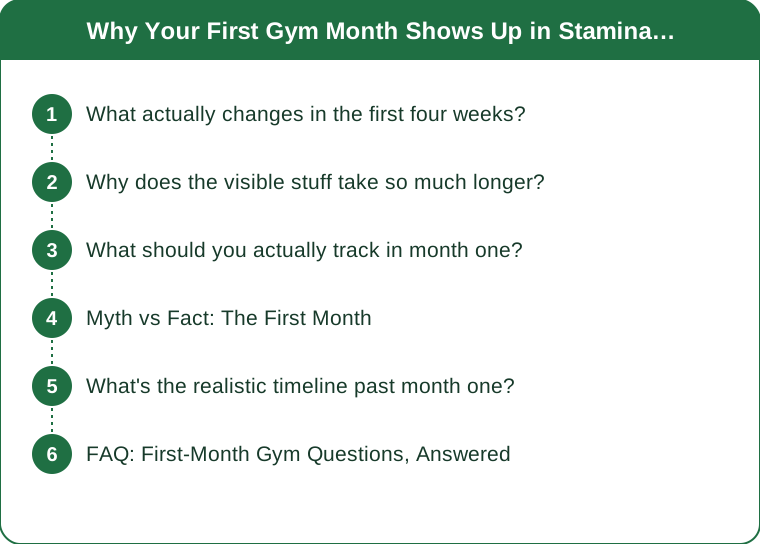
What actually changes in the first four weeks?
Early strength gains are dominated by neural adaptation — your nervous system getting better at recruiting the muscle you already have, coordinating it, and timing it. It’s a software update, not a hardware one.
At the same time, cardiovascular adaptations begin quickly: improved stroke volume, better capillary density over time, faster clearance between efforts. This is why work capacity — how much you can do in a session — usually improves before any single lift gets dramatically heavier, and long before body composition visibly shifts.
Why does the visible stuff take so much longer?
Meaningful changes in muscle size require sustained protein synthesis exceeding breakdown over weeks and months, and visible fat change requires a sustained energy balance over a similar timeline. Both are structural, and structure is slow.
Most people also underestimate how much visible change is required to be noticeable through clothing — considerably more than the change required to feel a difference in performance. Performance is a sensitive instrument; the mirror is a blunt one.
What should you actually track in month one?
Track the things that are actually moving. Reps completed at the same weight. How many minutes before you need a break. Whether the stairs still register. Resting heart rate, if you have a wearable.
Specific and useful: log every session with weight, reps, and a 1-10 effort rating. Four weeks of that log is far more motivating than four weeks of mirror checks, because it shows change that’s actually happening on the timescale you’re looking at it.

Myth vs Fact: The First Month
Myth: No visible change in a month means the program isn’t working. Fact: Visible change in a month would be unusual. Performance change in a month is the standard, expected result.
Myth: Soreness measures how effective the session was. Fact: Soreness mostly reflects novelty. It fades as you adapt, and its absence in week four is a sign of progress, not of slacking.
Myth: Beginners should train hard every session to catch up. Fact: Beginners adapt exceptionally well to moderate, consistent volume — and drop out at high rates from aggressive starts. Consistency beats intensity here more than at any other stage.
Myth: The scale is the honest measure. Fact: Early training often comes with increased muscle glycogen and associated water retention, which can hold the scale flat or nudge it up while everything else improves.
What’s the realistic timeline past month one?
A rough, honest sequence for most beginners training two to four times a week: weeks 1-4 bring coordination and stamina, weeks 4-8 bring clear strength increases on specific lifts, and weeks 8-16 are where visible change typically begins to register — first to you, later to other people.
The practical takeaway is about survival: the highest-risk moment for quitting is week three to five, precisely because it sits after the novelty wears off but before visible change arrives. Knowing that the gap is structural rather than personal is most of what gets people through it.
FAQ: First-Month Gym Questions, Answered
Am I doing something wrong if I’m not sore anymore?
No. Reduced soreness by week three or four is a normal adaptation. Progress is measured by what you can do, not by how much it hurts afterward.
How many days a week should a beginner train?
Two to three full-body sessions a week is a well-supported starting point and leaves enough recovery to actually adapt. More sessions aren’t better if they compromise consistency.
Should I add cardio in the first month?
Walking is a low-cost addition that supports recovery rather than competing with it. Adding hard cardio on top of a brand-new strength routine in month one is usually more than needed.
TL;DR:
- Month one produces neural and cardiovascular adaptations, not visible ones
- Feeling stronger and recovering faster is the correct first result
- Track reps, effort ratings, and daily-life stamina rather than the mirror
- Visible change typically begins somewhere around weeks 8-16
- The dropout danger zone is weeks 3-5 — knowing why makes it survivable
Nothing is going wrong. The first month’s results just live in your logbook and your stair-climbing rather than in the mirror.
Keep Reading
This article is for general informational and styling purposes only. Fit, sizing, and product availability may vary.
